The Elfland Prepositions

The Elfland Prepositions is a collection of four previously unpublished short stories :
Cleaning up Elfland
The Barmaid from Elfland
John Z. Delorean, Dry Cleaner to the Queen of Elfland
A Detective in Elfland

Click on link or photo to order.

Elfland is not a nice place, but it’s important to know how it works.

— Henry Wessells. The Elfland Prepositions. Temporary Culture, 2025.
Printed on Mohawk superfine white eggshell.
First edition, 326 copies printed, signed by the author. (26 copies, lettered A to Z, were reserved for presentation ; there were also 100 copies numbered 1 to 100). Heavy card wrappers, front cover with a photograph of a border of Elfland.
ISBN13 978-0-9961359-0-0 ISBN 0-9961359-0-1

SPECIAL SALE PRICE $25 (postpaid in U.S.)
through 31 December 2025

— — —

“elegant” — MICHAEL DIRDA, in the Washington Post

“Here is an Elfland as implacable as ever, but now ruthlessly enmeshed in contemporary mortal affairs.” —  MARK VALENTINE

“very clever, beautifully dark in implication. [. . .] Wessells is not prolific at all (in fiction) but what he does is outstanding.” — RICH HORTON

”If you don’t believe in magic, read Henry Wessells and find out how wrong you are.” — GUY DAVENPORT

Thirty-five years of Temporary Culture


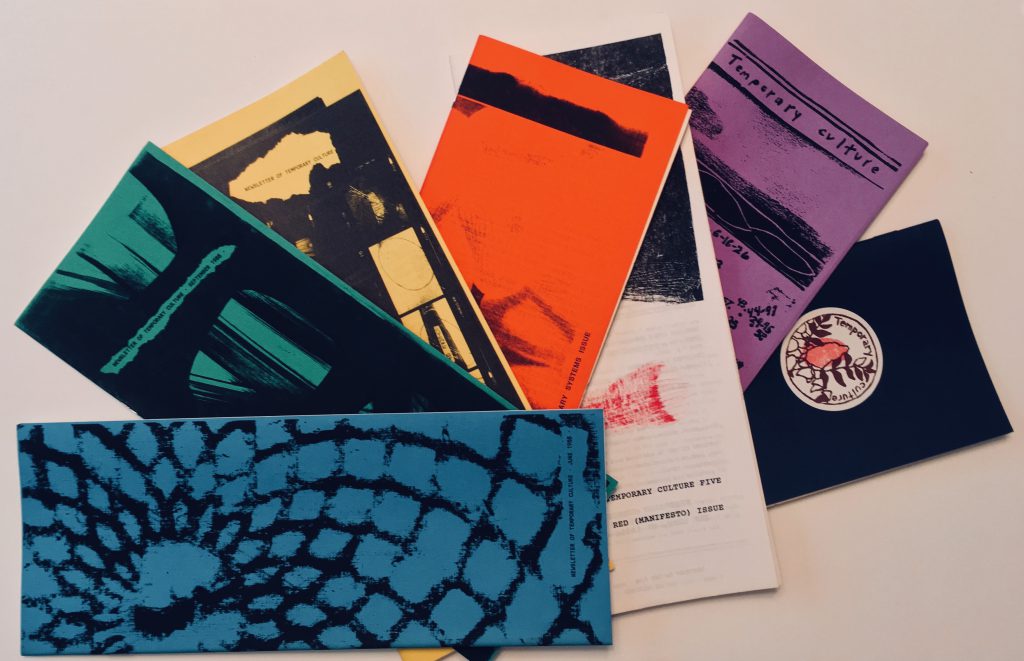
TEMPORARY CULTURE started with a photocopy ’zine at the end of June 1988, The Newsletter of Temporary Culture, the title from a dream-memory, and the form and content being a confluence of available technology and literary urges in the post-industrial not-quite-gentrified Hudson river littoral in Paulus Hoek (five minutes’ walk from downtown Jersey City). With the fifth issue the word newsletter fell away from the title and the seventh issue introduced the sumac logo and marked an end to a rainbow of ’zines (the eighth issue never made it to the copy machine).

the cover of the first issue, light blue, was a rubbing of a coal chute cover in front of a house on Van Voorst Park in Jersey City

And then the world changed.

Temporary Culture evolved with the newly available technology just as my interest in Avram Davidson ripened to the point of publication, and a friend said, you don’t really want a database, let’s make a website. An electronic newsletter followed, but the itch to produce printed things resurfaced before long, first with the publications of the Avram Davidson Society, and then from 2003 a steady series of books, including Another green world, When They Came by Don Webb,  Hope-in-the-Mist by Michael Swanwick, and the specially bound copies of A Conversation larger than the Universe. (In retrospect, it would have been cool to accept the hand press and founts of type offered to me in late 1992 or early 1993, but at the time I had nowhere to house them and so a different path was chosen.) The most important book published by Temporary Culture is without a doubt Sexual Stealing by Wendy Walker; the most elegant is the hand printed edition of Naples by Avram Davidson. Of each one of these (and of each of the books of Temporary Culture) I can assert that without my energies these books would not have come into being. A checklist of the publications of Temporary Culture is in preparation. There will probably be a few more books before it’s over.
The latest publications of Temporary Culture are new editions of Sexual Stealing by Wendy Walker, first published as an artist book in 2021, and now available as an equally beautiful trade paperback, printed and distributed by the workers cooperative Levellers Press, and as a full color e-book (in pdf format) distributed by Weightless Books. It is exciting to be able to offer Wendy Walker’s work to a wider audience.

‘A Full Moon in March’ : Special Sale on ‘A Conversation larger than the Universe’

“erudite and altogether fascinating” — Publishers Weekly”

an important book” — Foundation

A Conversation larger than the Universe was the first ever science fiction exhibition at the Grolier Club in New York City. The exhibition was held from 25 January to 10 March 2018, and an illustrated record can be seen here.

For the month of March, Temporary Culture announce a special sale on the book issued in connection with the exhibition, A Conversation larger than the Universe by Henry Wessells.
If you haven’t read it yet, buy yourself a copy now! If you have read it, send a copy to a friend.


The trade edition, regularly priced $35.00, is available for $25.00 (postpaid in U.S.A.).

The Subscriber edition, signed by Wessells and John Crowley, with Reading in Public, signed by Michael Swanwick, regularly priced $300.00, is available for $250.00 (postpaid in U.S.A.).

(sale price for all orders through 31 March 2021)

signed by John Crowley

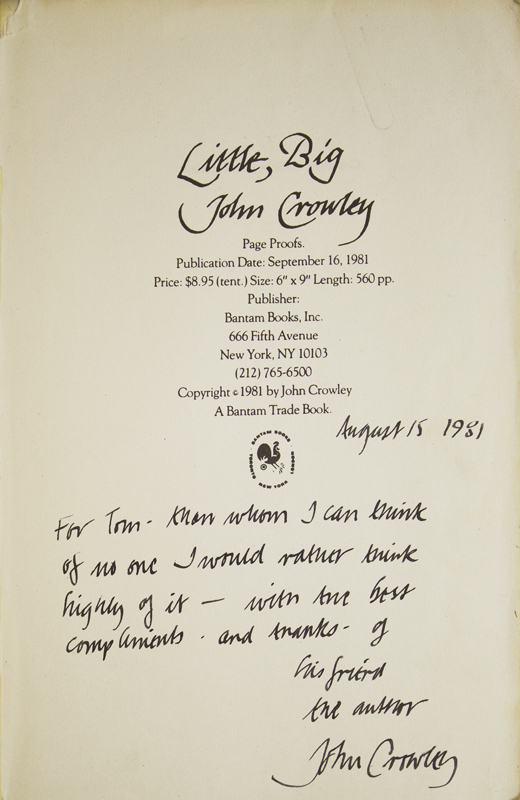
John Crowley. Little, Big. New York: Bantam, 1981. Inscribed to Tom Disch.


An unexpected pleasure while writing A Conversation larger than the Universe was when my friend John Crowley agreed to write a foreword for the book. “A Hatful of Adjectives for Henry Wessells” is playful and will delight all who read it. The foreword also contains a sentence of rare power and insight crossing centuries from Hamlet to Lewis Carroll’s Alice and Crowley’s own masterpiece, Little, Big.

My friendship with John is rooted in books (no surprise, there). In early 2001, I wrote a piece on Little, Big for David Hartwell, “Appraisal at Edgewood”. When it appeared in my collection of short stories, Another green world (2003), I sent a copy to John. We would see each other at Readercon, and so on. Temporary Culture even proposed to publish Endless Things when it was in the wilderness but John sagely remarked he was seeking a wider distribution for the novel. I first met Gavin Grant and Kelly Link when Kelly read from Stranger Things Happen at the KGB Fantastic Fiction reading series. When Small Beer announced publication of Endless Things, Gavin suggested a small edition binding for presentation copies. I was happy to participate.

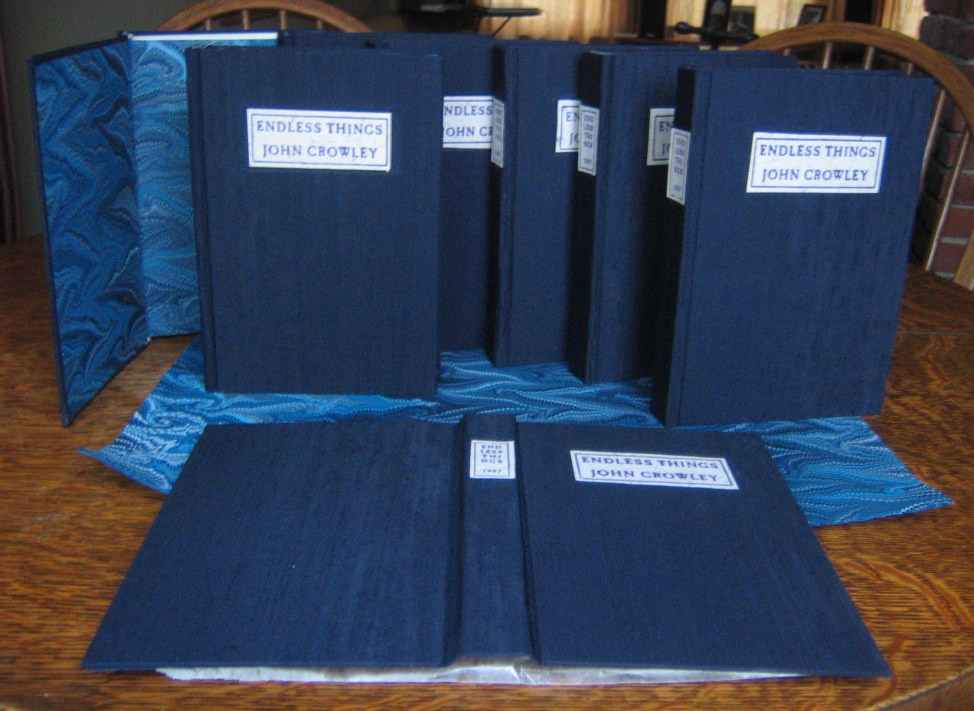
Endless Things, presentation bindings

Endless Things. Presentation bindings for Small Beer Press, May 2007.

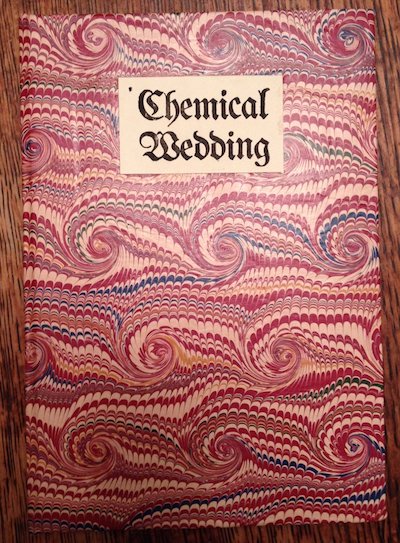
Of course Gavin remembered this during his preparations for publication of John’s version of The Chemical Wedding and so a single specially bound copy was commissioned for a patron of the edition. What fun!

The Chemical Wedding by Christian Rosencreutz. A Romance in Eight Days. One copy, for Small Beer Press, 2016.

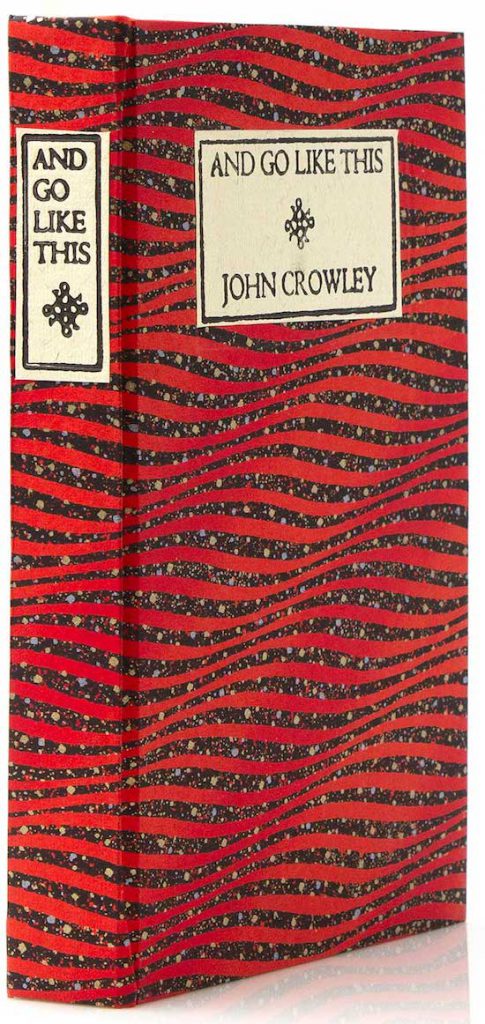
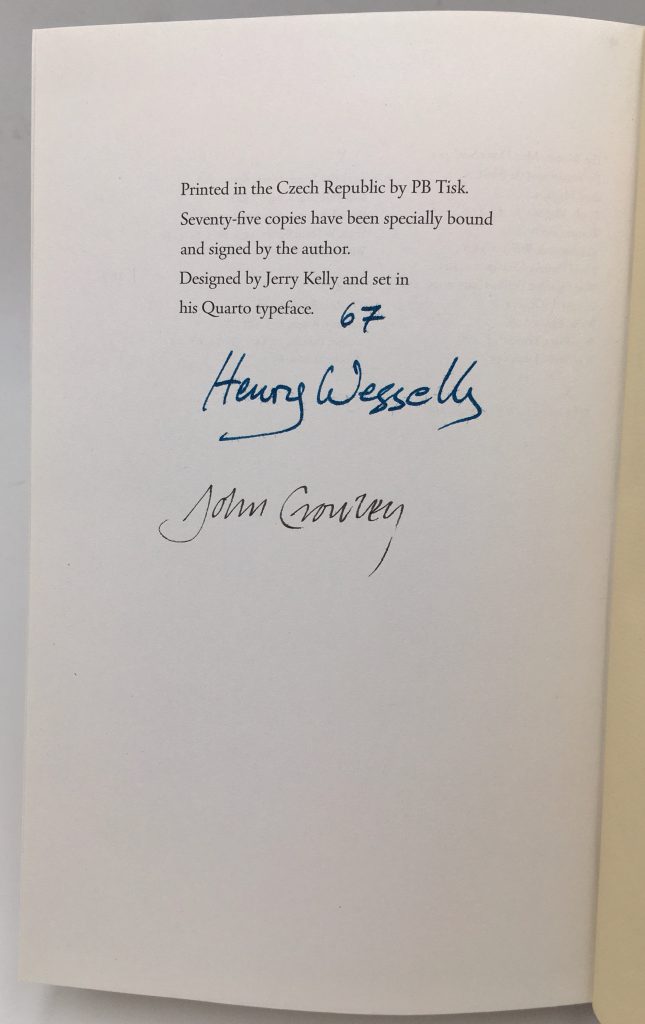
Given this long entanglement, how could I resist the challenge of creating an edition binding for the signed copies of And Go Like This? When he first saw the bindings, Gavin wrote to say “the waves in the world are the waves in the words”. I am honored to be part of such a fine book.

And Go Like This. Edition of 26 copies for Small Beer Press, November 2019.

The binding on the subscriber copies of A Conversation larger than the Universe was simple by design, handsomely executed by Trevor Rutherford with a hand printed label from the press of Jerry Kelly. John Crowley and I signed them one fine March morning in 2018. A few copies are still available.

And there are plenty of copies of the regular edition of A Conversation larger than the Universe In addition to the “Hatfulnof Adjectives”, there is an entire chapter devoted to Little, Big.

The poet in his library

A couple of the poems in The Private Life of Books were written in memory of friends who have died. “The algorithm of Serendipity ; or, The poem in the bookshelf” recalls the shop of Berkeley bookseller Peter Howard, which lived up to its name, Serendipity, as one would always find something apt or interesting in the labyrinth. David Streitfeld put it succinctly in a note in the New York Times upon the closing of the shop: “Mr. Howard wanted people to search for books and find not just what they were looking for but the book next to it, which they might want more if they only realized it existed”.

The fifth poem in the sequence, “The poet in his library”, was written in memory of poet and science fiction author Thomas M. Disch (1940-2008). I knew Tom during the last couple of years of his life, and we got on well. He was despondent all the years I knew him (had been since the death of his partner Charlie Naylor, I guess), only the gloom was often leavened with flashes of humor and dark glee. The portrait above is a still from filmmaker Eric Solstein’s recording of Tom reading from his poem cycle, Winter Journey, clips from which were screened at the NYRSF Reading Series Tribute to Thomas M. Disch on 5 June 2018.

During the production of The Booksellers, director D.W. Young taped me reading several of the poems from The Private Life of Books. He kindly made the file available and so here is “The poet in his library” :

Second Edition; or, Becoming a Book

How does a book get written?

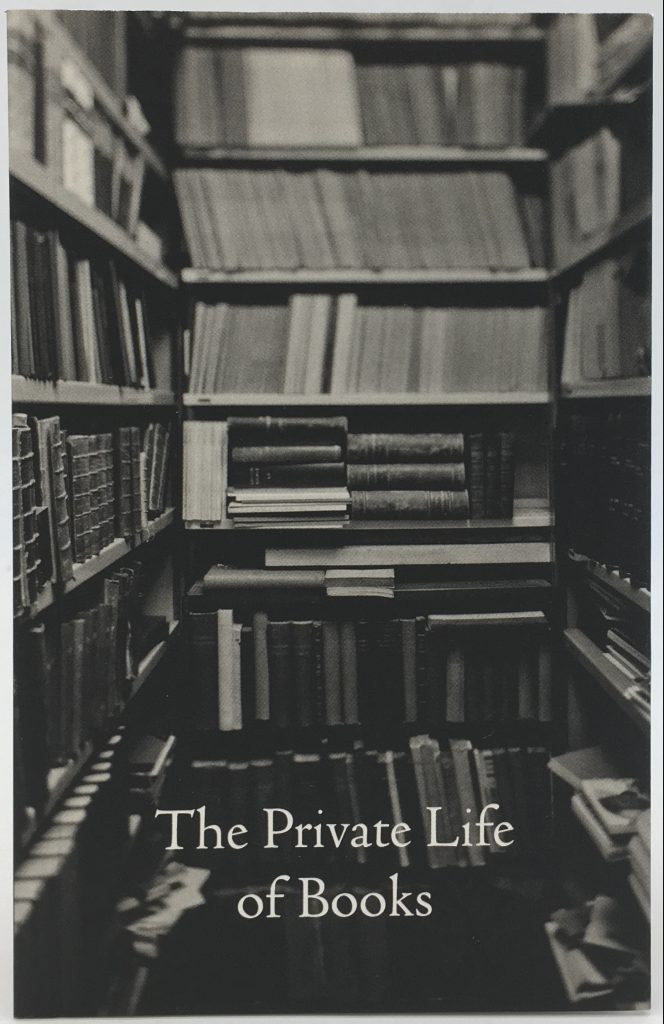
The Private Life of Books is a sequence of six poems composed over a period of fourteen years. Even that single sentence conceals as much as it discloses. In my personal and professional life I look at books and think about them. The Private Life of Books is that thinking put down on paper. The title poem has its origins in a worn, heavily annotated book that came across my desk one day. The other poems in the sequence are about the idea of books as much as they are about (or for) people whom I have known, as reader, writer, bookseller, and friend. I wrote the first poem in August 2001, and part of the second poem (How books are made) a year or so later. Then there was a long interval of silence. After four years, I knew how to finish the second poem, and to begin or write three more within a year (two marking the deaths of friends). I had sent these off to various journals as they were written, to further silence. The poems are unrhymed irregular sonnets somewhat after the manner of Ted Berrigan. There are no footnotes to any of the poems.

The photographs are inseparable from the book. Paul Schütze, an Australian-born artist long resident in London, explores perception and the senses. His art encompasses music, photography, and scent. Some years ago he began a series of nocturnes, photographs by ambient or diminishing light at the John Soane Museum, at booksellers Maggs Bros. (then in Berkeley Square), and in other interesting spaces. Ed Maggs introduced us and the collaboration on The Private Life of Books is the result. I asked Jerry Kelly to design the book, and he was resilient enough to incorporate a sixth, unexpected poem written while the book was in proof.

In September 2014, the first edition was published. The reviewer for The Book Collector caught the mood: “marvellously sombre”. Another reader described The Private Life of Books as a Gesamtkunstwerk in book form. One of the original subscribers was Dan Wechsler, producer of The Booksellers, a documentary on the world of rare books in New York City. Director D.W. Young asked me to read the title poem in various shops and offices during the production of the film. Each take was successful, except for the intrusion of unmistakable New York sounds: a police siren, the whir of an air conditioner, or a door slamming in the distance. So, late in the process, I made a recording in a studio, which was used as the concluding voiceover to the film.

This second edition of The Private Life of Books, also designed by Jerry Kelly, includes all the photographs of the original edition in smaller format. Happy reading!

A Conversation larger than the Universe

A Conversation larger than the Universe was an exhibition on view at The Grolier Club in New York City from 25 January through 10 March 2018. A Conversation larger than the Universe is a history of science fiction in seventy literary artefacts and a highly personal tour through the bookshelves of Henry Wessells. The books (many signed or inscribed by their authors), magazines, manuscripts, letters, and artwork date from the mid-eighteenth century to the present and explore the ideas and people that have defined the literatures of the fantastic, from Mary Shelley and H. G. Wells to Philip K. Dick, Joanna Russ, James Tiptree, Jr., and William Gibson, as well as works by W. H. Hudson, Richard Jefferies, and others not so widely known today. Beginning with the origins of science fiction in the Gothic, this ‘Conversation’ contemplates topics such as the End of the World (and After), Imaginary Voyages, Dystopia, Women Authors, Literary Innovation, Humor, the Sixties, Rock ’n’ Roll, Cyberpunk, Steampunk, and what’s happening in science fiction and the fantastic right now. The exhibition adopts a broad description of Science Fiction encompassing Fantasy and Horror as well as bibliography and scholarship in the field.

The EXHIBITION tab on this website presents a record of the books and other materials exhibited

The Grolier Club has posted photos of the exhibition installation here: https://www.flickr.com/photos/grolierclub/sets/72157668998324669

— — — —
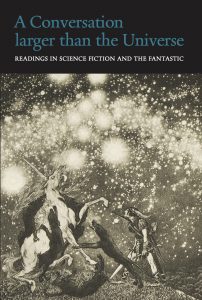
A Conversation larger than the Universe. Readings in Science Fiction and the Fantastic 1762-2017 is an illustrated collection of essays to accompany the exhibition, including a descriptive checklist of the materials on view, published by The Grolier Club. The book includes ‘A Hatful of Adjectives’, an original Foreword by John Crowley. Book design by Jerry Kelly. Several sections of the book appeared in Wormwood, Foundation, and The New York Review of Science Fiction in advance of book publication.

Size : 6 x 9 inches, trade paperback, pictorial wrappers with french flaps. 288 pp. With more than 100 illustrations; index. ISBN 978-1-60583-074-2. Price: $35.00. ORDER A COPY.

— — — —

Subscriber Edition
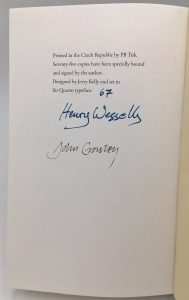
A Conversation larger than the Universe. Readings in Science Fiction and the Fantastic 1762-2017
By Henry Wessells
Foreword by John Crowley
Issued with an original short short story, Reading in Public, by Michael Swanwick.

Published by Temporary Culture in an edition of 75 copies, signed by John Crowley and Henry Wessells.
6-1/8 x 9-1/2 inches, 288 pp. With more than 100 illustrations; index.
Hand bound in sand cloth with letterpress label.
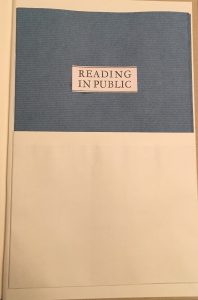
With: Reading in Public (stitched in blue Hahnemühle wrappers with printed label, signed by Michael Swanwick).
Note: Reading in Public is original to this edition and does not form part of the trade edition.
ISBN 978-0-9961359-4-8. Price: $300.00. ORDER A COPY.

— — — —

Reviews & Related Publicity

“erudite and altogether fascinating . . . In the year of Frankenstein’s bicentennial, this is essential reading”
Publishers Weekly

‘a stunning exhibition’
Gary Wolfe reviewed the book in the January issue of Locus magazine.

Michael Dirda reviewed the book in the Washington Post on publication day (25 January 2018).

Mark Valentine conducted a two-part interview in the week prior to publication for Wormwoodiana, part one on 17 January and part two on 18 January.

Gil Roth interviewed Henry Wessells for the Virtual Memories podcast (show 255, 5 February 2018).

A British publication, Tank Magazine, also reviewed the exhibition. The Library of America published a short illustrated interview on Friday 2 March.

The Book Collector (for Spring 2018) called the Conversation “much more than a catalogue; it is an engaging illustrated history of a sometimes undervalued genre . . . a most enlightening assemblage.”

Andy Sawyer reviewed the book for issue 131 of the U.K.-based Foundation: the international review of science fiction and observed “[d]isguised as a catalogue, this is an extremely valuable book about what we think of the fantastic and why.”

Locus magazine included the book on its Recommended Reading List.

The Private Life of Books

The Private Life of Books

Temporary Culture is pleased to announce the publication of a new edition of The Private Life of Books, containing poems by Henry Wessells on reading, memory, and other topics. The photographs by Paul Schütze document the Berkeley Square shop of London booksellers Maggs Bros. (they have since moved to Bedford Square). The Private Life was originally published as an artist book in September 2014, and the title poem features as the concluding voiceover in D.W. Young’s documentary, The Booksellers. Designed by Jerry Kelly, this beautifully printed small format edition is, as Mark Valentine observes, “suitable for a gentleman-scholar’s waistcoat pocket, for consultation upon occasion, or for the reticules of learned ladies.”

Temporary Culture started as a photocopy ’zine in the summer of 1988. The sumac and fingerprint logo was adapted from a blockprint by A. Wessells and used as stickers produced for the seventh issue (1992). The publishing activities of Temporary Culture have always been connected to the literature of the fantastic and have included web content since 1995 (starting with the Avram Davidson website). The Temporary Culture website includes a visual record of A Conversation larger than the Universe, the first ever science fiction exhibition at the Grolier Club in New York City.

Happy reading!